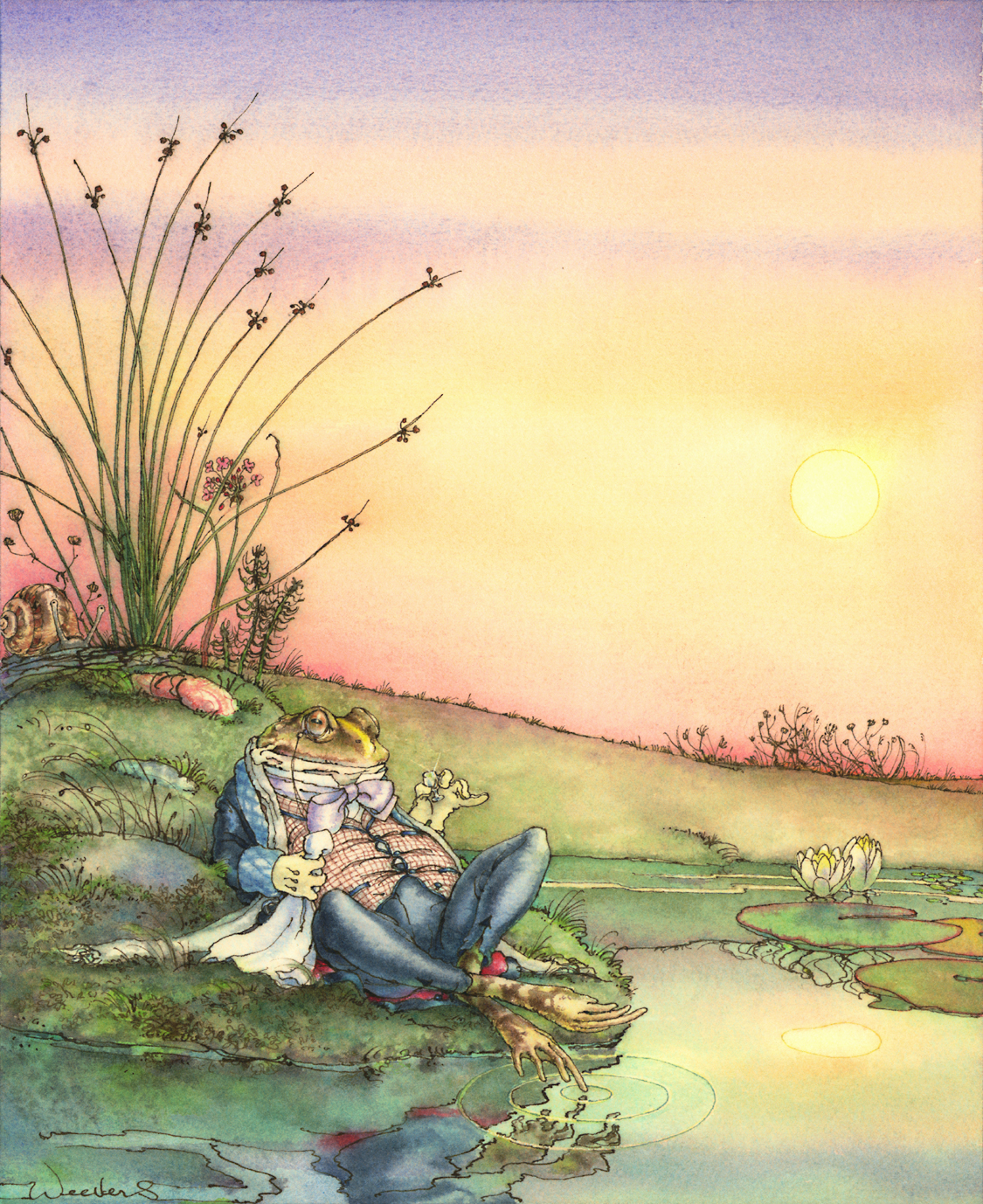
The Gourmet Frog


The gourmet frog
Will leap at chances
Or make direct advances
With his eloquent,
Extensive tongue

To secure his favourite food
That others may find crude
Or perhaps a little
Underdone.

 He takes his time to savour
 That fine, distinctive flavour
Of escargots
With blue-bottle fly

 Then, quite conceivably,
A little eau-de-vie
And a thought
 As he taps his thigh..

  * 
  La grenouille gourmet
Saute sur les chances
Ou fait des avances
Avec sa langue éloquente
Et étendue

Pour attrapper son repas
Que d'autres ne dégustent pas
L'estimant répugnant
Et assez cru

La grenouille prend le temps de goûter
En fine sauce baveuse et veloutée
Des escargots- aux mouches bleues
Pour son délice

Puis sereinement accroupie
Sirotant son eau-de-vie
La grenouille songe, en tapotant
Sa cuisse. 


   *
La buongustaia rana
Salta sulla fortuna,
O fa delle avances
Con la sua lingua
Lunga ed eloquente

Per prendere il suo cibo
Che altri trovano crudo,
Stimandolo poco cotto
E repellente.

Ha sempre tempo per gustare
Distendosi per assaporare
Degli escargots con moscone
Blu bottiglia.

Poi forse per finire
Un'euforica acquavite,
E un pensiero toccando
La sua coscia.
_

Although The Gourmet Frog is a French, epicurean frog, the poem 
(or doggerel for the 'purists') naturally has a distinct, Anglo-Saxon (or Anglo-Scottish) flavour. The style of the illustrations might also be considered classical Anglo-Saxon, even if- and perhaps also because- it was perfectly natural for the artist to create the Animal series, at a particular period of his life for his own amusement.

Some of the series have been published in books and also in card form, with the original 'doggerel' in the latter case. 

Occasionally more of them will be shown on Viewfinder.

Because of the Anglo-Saxonism, especially characteristic to this particular work, it seems fitting to try to retain this quality as much as possible in the translations, which in my view makes them also an interesting challenge.

If there are any French or Italian poets (or writers of 'doggerel'- an art in itself) who think they might be able to write amusing versions of the above efforts, I would be very interested in reading the results.
I would also be delighted, and most willing to add any worthy contributions, most certainly as comments, and even more so if they are written by children (of all ages). 

This note could also apply to any future publication of examples of the Animal series on Viewfinder, concerning poem translation in French and Italian, or in any other language, for that matter.
__  

Poems and illustration © Mirino (PW). August, 2011
With thanks to Rob (Wind Rose Hotel) for his advice re. the Italian version.

Obamacare


Barack Hussein Obama often saunters up to his rostrum to make public statements. Although inaudible to some, one can imagine that the most recent ones basically consisted of justifications regarding the stance of the Democrats, and remonstrations regarding the stance of the Republicans.

Idealism is praiseworthy, above all when it's tempered with realism. Obamacare is a commendable ideal, but would the setting up of such a costly health-care system, during possibly the worst financial crisis in history, and when the USA has never been more deeply in debt, be realistic?

He would be quite right to expect well-off Americans to help more in shouldering the financial burden, but he would be quite wrong not to pull back just as much, if not more, on his ambitious, public spending programs.

To help solved the insolvable, the debt ceiling level has been raised. This seems to imply that the US can continue to play for time, instead of adopting more austere measures- the stringent steps called for and expected regarding European countries far less in debt, for example. It's difficult to follow the US Congress theory that the federal debt will be reduced in ten years time by raising it's ceiling level.. No doubt extra intelligence is require to understand such 'high finance' subtleties.

Obama therefore seems to be doing his best to explain how such situations are developing, perhaps less swaggeringly confident that he will succeed in regaining the pubic support he so enjoyed during the first year following his election. But it appears that he is stuck in a deeper hole than ever, and no one, certainly on the Republican side, is showing any eagerness to help pull him out.

Consequently US foreign commitments could be increasingly limited. The world is informed that 10,000 American troops are leaving Afghanistan this year. A further 20,000 will be leaving Afghanistan next year.
It's difficult to imagine the Taliban making public announcements to inform the world that several thousand of their forces will be pulling out at any given time.

Obama's latest declaration regarding foreign affairs was a sweeping statement underlining that on no account will there be any military intervention in Syria.
Assad must also be delighted to hear this affirmation, that as far as the US are concerned, he can continue without impediment to encourage and congratulate his army for their courageous and patriotic stand, in regularly massacring mostly unarmed, Syrian civilians.

One only hopes that the EU will be more forcefully realistic and idealistic regarding Syria. Almost on a daily basis the Syrian people are sacrificing themselves for an ideal which, at least in principle, the free world is supposed to defend. One can't defend the principle of democracy in Afghanistan, Iraq and Libya, and at the same time be virtually a tacit accomplice to systematic assassinations of unarmed civilians whose only crime is to manifest for the same freedom in Syria.
One either defends the principle of democracy or not. Incoherent double standards are usually only practised by cowards or hypocrites.

There is also a paradoxical twist regarding the terrible situation in Somalia. In order to help well over two million famine victims, it seems that the US are considering the possibility of easing restrictions imposed on the extremist Islamist group al-Shabab, the killers of Western aid workers. This might mean that in the hope of getting some of the much needed food supplies through, al-Shebab could even be paid 'taxes and tolls'. In any case it's probable that when restrictions are lifted, much of the supplies will also be creamed off by the extremists, to add insult to injury.

Such an idea seems senseless. Surely this massive catastrophe deserves a far more important, international engagement. In order to insure that precious food and medical supplies get through to the famine victims, shouldn't these supplies be escorted by strong contingents of UN or NATO forces?

The world is precious, and still beautiful, but it badly needs a lot more care and attention, certainly from those who are willing to give it. Needless to add, the USA, the great nation that has always claimed to extol freedom above all others, should continue to play a prominent role.
___

Opinion and water-colour vignette © Mirino, August, 2011

Edmund Spenser


Across history humanity has always been orientated by, and sometimes obsessed with, the timeless combat between what is considered according to each epoch as 'good and evil'. The combat is often 'religious', but it doesn't always have to be. Religion is frequently used however, as a justification to wage war against whatever is decreed as 'evil', determined by whatever interests are at stake at such times.

When opposing forces claim that God is on their side, the combat against 'evil' is thus often relative to one's interests.
When 'progress' is the criterion, for example, those who try to oppose it would be classed as evil elements- the baddies, as the North American Indians defending their land and way of life were regarded and characterised, even up until the early 60's. Or when, for life's survival, the defence of the environment becomes more important, technological progress tends to be ostracised in favour of the former. Whatever the historic facts, we then start believing that the North American Indians, who were either wiped out or exiled to allocated reserves, were right after all.

Tolkein's The Lord of the Rings magnificently exposes the evil of hate, greed and obsessive desire for power, but the recent film Avatar could be regarded as a more up to date version of this particular modification of values.
In today's world the abuse of tyrannical and/or financial power are continuing to culminate causing radical consequences of enormous social impact world-wide. And as a further, minor example, words such as immigration and integration are bound to take on new connotations when increasing numbers of hosted immigrants refuse to integrate. Inevitably this too contributes to social change.

The Crusaders had 'God on their side' and their enemies were the 'heathens'. Concurrently, the Muslims had 'God on their side' and their enemies were the 'infidels'.

But evil certainly exists. Whatever it claims, it never has God on its side. From time to time it raises its ugly head and spews its hate on the entire human race and life in general.

In Edmund Spenser's epic poem, The Faerie Queene, evil has many faces. Spenser gave it hideous, complex and perfideous forms that remind us of modern interpretations brought to horrific vividness via computer technology. This, even though the poem was written as long ago as the 16th century.

Edmund Spenser is classed as 'the greatest, nondramatic, English poet of the Elizabethan era'. (Nondramatic meaning he wasn't a playwright).
He was born ca. 1552, in London and started his schooling at the Merchant Taylor's School before going to Cambridge in 1569 as a 'poor scholar' (sizar).  His interest in poetry grew from his translating verses from anti-Catholic propaganda. He experimented in quantative versification with his friend and humanist, Gabriel Harvey.
Spenser received the A.B. degree in 1573 and the A.M. in 1576 after which he served as personal secretary to Dr. John Young, bishop of Rochester, as well as Queen Elizabeth's favourite, the Earl of Leicester. During this period he made acquaintances with Sir Philip Sidney and Edward Dyer, courtiers interested in launching 'new English poetry'. Spenser's contribution to this was The Shepheardes Calender (1579). He dedicated it to Sidney.

Spenser, who greatly admired Chaucer, used archaic, Chauceresque language to give his poem more rusticity. Sidney however, being a purist, didn't approve.
Since then Spenser's skill and the 'melody' and variety of his verses are widely recognised and appreciated. He was a great experimenter. There are 13 different meters in The Shepheardes Calender. Most of them were new. Only three or four of them were fairly common in 1579.

Such innovations are best known in The Faerie Queene. It's nine-line stanza and it's six-foot line finale are fine examples.

Spenser is sometimes referred to as the 'poet's poet', because so many poets learnt from him and were inspired by him.

After the publication of The Shepheardes Calender, Spenser had to go to Ireland as secretary to Lord Grey of Wilton, lord deputy of Ireland. He tried to obtain posts in England but in vain. During his stay in Ireland he wrote a strong apology for the brutality of the English colonial regime- A View of the Present State of Ireland.

Sir Walter Raleigh visited him when he was writing his epic The Faerie Queene, in Kilcolman Castle. Spenser was hoping, with Raleigh's influence, that his poem would gain the favour and patronage of the queen. The six book epic was published in 1596. He wrote this letter to Raleigh regarding his master-piece in 1589.

During the Irish revolt and civil war, Kilcolman castle was destroyed. Spenser was then sent to England to convey messages from the besieged English garrison.

He died the 13th January, 1599 in Westminster and was buried in 'poet's corner' of Westminster Abbey near the grave of Chaucer. He had always revered Chaucer, and like many romantics, preferred the past to his own era, yet his innovations paved the way forward and inspired great poets such as Milton, who regarded him as 'a better teacher than Scotus or Aquinus'.

His spelling has never been altered. Only his confusing punctuation has partly been modified. His spelling suggests rhymes to the eye though often incorrect, even according to his own era. But it was also the fashion of the Elizabethan epoch, not only for poets, to exercise considerable licence regarding spelling.

Spenser was a great analyst of good and evil, recognising the latter in all its diabolical and insidious forms and appearances. As a staunch Protestant he diabolised the Roman Catholic Church which was considered a dangerous threat to the English Crown also under Queen Elizabeth.

The Faerie Queene, consists of six books of twelve cantos each, thus imitating Virgil's Aeneid. It exposes the virtues of Holiness, Temperance, Chastity, Friendship, Justice and Courtesy. It's basically an epic combat between good and evil in all its forms. It depicts Knights and ladies, chivalry, nobility, Arthur, Merlin, magic trees, 'Saracens', dragons, guardian lions, magicians, giants, evil hags, warlocks and witches, etc., including a vivid description of the parade of the seven deadly sins, whipped along by Satan.
English patriotism and Queen Elizabeth herself are symbolically incorporated and fiercely defended. The Redcrosse Knight is the virtuous knight (as well as St. George, patron saint of England).
The poet often draws on Italian and Greek classics as well as classical theology and allegories. His sources include Ovid, Virgil and Homer.
In the following, very short excerpt, Spenser even associates Roman Catholicism with the most vile and evil dragon, which well illustrates the above argument that what is often conceived to be 'good and evil' is more often than not based on the historic evolution of social, geopolitical and economical interests and requirements.

(...)
Much daunted with that dint,° her sence was dazd            °blow
Yet kindling rage, her selfe she gathered round,
And all attonce her beastly body raizd
With double forces high above the ground:
Tho° wrapping up her wrethèd sterne arownd,                  °then
Lept fierce upon his shield, and her huge traine°               °tail
All suddenly about his body wound,
That hand or foot to stirre he strove in vaine:
God helpe the man so wrapt in Errours endlesse traine.

His lady sad to see his sore constraint,°                             °entrapped state
Cride out, "Now now Sir Knight, shew what ye bee,
Add faith unto your force, and be not faint:
Strangle her, else she sure will strangle thee."
That when he heard, in great perplexitie,°                        °his fettered state
His gall did grate for griefe° and high disdaine,               °wrath
And knitting all his force got one hand free,
Wherewith he grypt her gorge° with so great paine,         °neck
That soone to loose her wicked bands did her constraine.

Therewith she spewed out her filthy maw
A flood of poyson horrible and black,
Full of great lumpes of flesh and gobbets raw,
Which stunck so vildly, that it forst him slacke
His grasping hold, and from her turne him backe:
Her vomit full of books and papers was,¹
With loathly frogs and toades, which eyes did lacke,
And creeping sought way in the weedy gras:
Her filthy parbreake° all the place defilèd has.²                  °vomit
(...)

¹ The books and pamphlets consisting of Catholic propaganda attacks against Queen Elizabeth in 1588.
² Revelation 16.13: And I saw three unclean spirits like frogs come out of the mouth of the dragon, and out of the mouth of the beast, and out of the mouth of the false prophet.

__

Without considering the Jewish religion, the Roman Catholic Church might still consider Protestants and Anglicans as heretics, and Eastern Orthodox as schismatic. Yet the schism between the Eastern Orthodox and the Roman Catholic Church was made irredeemably worse by the Fourth Crusade, (1202-1204) instigated by Pope Innocent III and cunningly exploited by the Venetian Doge. It led to the shameful sack of the Christian port of Zara and Christian Orthodox Constantinople.

Protestants were also known to victimise and execute 'heretics' after the Protestant reformation in the 16th century. But it was also the era of enlightenment, and it was this enlightenment (in sciences, astrology and the arts, etc.) that was perceived to be a threat to certain religious institutions, especially the Roman Catholic Church.

The inquisition was also initiated by the Church to suppress 'heresy'. They were active in several European countries and were fervently supported by the civil authorities. The most brutal inquisitional methods were practised by the Spaniards. They included burning 'heretics' at the stake.
The last victim to be burnt alive on orders from Rome was Giordano Bruno in 1600.
In his case the 'heresy' consisted of beliefs including Copernicanism. Most likely considered the worst 'evil' even then was his belief in an unlimited universe with countless inhabited worlds. A belief that certainly wouldn't be considered unreasonable or sacrilegious today.
More unbelievable is the fact that the last recorded execution for 'heresy' by Catholic authorities was that of the Spanish Schoolmaster Cayetano Ripoli in 1826. (His alleged crime consisted of teaching the principles of Deism).
There's no doubt that thousands of so called 'heretics' have been executed by diverse ecclesiastical authorities throughout 'civilised' history, far more out of fear and self-interests than for any professed sacrosanct combat against what was then falsely decreed as 'evil'.
__

Text © Mirino. Source- The Norton Anthology English Literature, with grateful thanks. Portrait of Spenser by an unknown artist, with thanks to Wikimedia Commons. August, 2011

François et Jacques


On dirait que les media françaises préfèrent tourner la page sur le dernier 'épisode Hollandais'. Mais à titre personnel, on se demande si la France devrait accorder tant de confiance quasi aveugle au plus éminent candidat de la gauche aux présidentielles dont le comportement a été assez évasif sinon suspect?

On fait encore allusion bien entendu à l'affaire Banon/DSK. Avec trop de véhémence, Monsieur Hollande nie toute implication, en admettant en même temps qu'il a été informé à l'époque de cette accusation de tentative de viol de Tristane Banon (février 2003) pendant un entretien qu'elle a eu avec l'ex directeur générale du FMI.*

Pour faire le point, aujourd'hui il importe peu d'accorder une importance ou non à cette accusation bien tardive de tentative de viol présumé de Banon. Ce qui semble important par contre est ce que Monsieur Hollande a dit dans son élan de s'écarter de toute implication. Il a dit que 'ce n'est pas à lui de donner des conseils de porter plainte ou non, que cela n'a rien à voir avec lui ni avec le parti socialiste', et manifestement ce n'est pas à lui non plus de réagir en aucune manière malgré l'ampleur de cette grave accusation concernant un collègue proche.

Peut-on permettre un tel manque d'engagement et de responsabilité d'un candidat potentiel des présidentielles?
Imaginons par exemple que Monsieur Hollande ait été le Président élu de la France pendant que Kadhafi tirait sur son peuple avec des armes antiaériennes. Imaginons que le peuple demandait de l'aide ou du conseil à la France, et une délégation représentant ce peuple brutalement opprimé rendait visite à la France pour demander son soutien.
Avec relativement la même attitude exprimée à l'égard du cas Banon, Monsieur Hollande aurait eu donc le droit de répondre que ce n'est pas à lui de donner des conseils pour ou contre, que cela n'a rien à voir avec lui, ni avec le gouvernement socialiste, ni donc avec la France, et ce ne serait manifestement pas à lui de réagir en aucune manière malgré l'ampleur de la gravité de la situation libyenne.

Monsieur Hollande né le 12 août 1954 à Rouen est le fils du Dr. George Hollande, médecin ORL. Il se peut que le Docteur n'ait jamais été le meilleur fan de Charles de Gaulle car il était favorable à l'Algérie française, carrément reniée finalement par ce dernier.

Le bilan de François Hollande n'est pas sans tâche ni incohérence. Il a eu quatre enfants avec Ségolène Royal avant que leur séparation soit officialisée, ce qui pourrait même être considéré plutôt positif.. Mais une tâche marquante concerne la période où il était conseiller général de la Corrèze, (lieu cher aussi à Jacques Chirac, gaulliste dévoué, qui a été élu conseiller municipal de Sainte-Féréole, en Corrèze en 1965).
Quand François Hollande était conseiller général de la Corrèze donc, (élu en 2008) il a fait objet de critiques assez aiguës en 2010 après qu'une publication d'un rapport de la chambre régionale des comptes du Limousin ait indiqué que les contribuables corréziens ont payé 1,5 millions d'euros chaque année pour financer le musée du Président Jacques Chirac.
Lorsque Chirac disait- selon lui ironiquement- qu'il voterait pour Hollande, peut-être sa déclaration était bien moins ironique qu'il voulait le faire croire..

*Notons que Hollande savait bien que DSK était le favori comme candidat des présidentielles du parti socialiste. N'aurait il pas été plus responsable, plus intègre et plus digne en tant que Premier Secrétaire du parti, et en tant qu'homme, d'avoir essayé de remettre DSK sur les rails après cette affaire, en lui rappelant sa responsabilité et à quel point le parti et des millions de français comptaient sur lui? Ne pourrait on pas alors être porté à la conclusion que Hollande a choisi de ne rien faire et ne rien dire pour des intérêts plus personnels?
__
  
Cet article avec d'autres étaient mis en 'draft' (retirés temporairement) après l'élection de Monsieur Hollande Président de la France. Ca ne voulait en aucun cas dire qu'ils n'étaient plus valables, ou que l'on a modifié ses opinions, ou que l'on manque le courage de ses convictions. Il s'agissait simplement d'un geste initial de respect envers le Président et envers tous ceux qui ont voté pour lui.
Depuis l'élection de Monsieur Hollande certains articles à l'égard des élections françaises pourraient en effet être considérés comme de l'eau passée sous le pont.
Si j'ai pensé que cet article figurât parmi eux, il aurait continué à rester exclu.
__

Text and dessin © Mirino. Source- general information and Wikipedia, with thanks. 
July 2011

Gobil and the Greenfly


Whilst flying home one misty day
The little Greenfly lost his way.
Not far from there old Gobil lurked,
Singing softly as he worked-

'Spin, spin, tuck it in,
Knit one split one, safety-pin.
Web is sticky, web is strong,
Dinner time will not be long.'


 The little Greenfly was so small
He never saw the web at all,
But landed upon Gobil's nose,
So grateful for the brief repose.

Old Gobil twitched then kept quite still,
Certain of his spidery skill,
But then he sneezed, (to his dismay)
And blew the Greenfly on his way.

*

A methodical fly got caught 
In a web a spider had wrought,
But he stayed very still
And made out his last will
As his life would soon end,
He thought.

The spider, however, was old,
And had recently caught a bad cold.
When he started to cough
He shook the fly off,
And this tale the fly
Later told.
__
 
For the Rainbow alphabet doggerel, please go here
__

Image and doggerel © Mirino (PW), July, 2011

Scottish myths 5


Thomas the Rhymer

It's said that the Eildon Hills consisted of one high ascent until the alchemist wizard, Michael Scott (ca. 1175 - 1232 ) ordered his imps- Prim, Prig and Pricker, to divide it into three hills. The north hill was where the largest Roman fortress of Scotland was built. Remains of the fort still exist.

Near the hills grew the Eildon tree, a favourite haunt of Thomas of Ercildoune (Earlston). One day as he lay beneath his tree, the Fairy Queen rode by on a noble white steed. She wore fine, green silk and crimson velvet, and fifty nine silver bells hung from the horse's mane.

It was no chance meeting, for the Fairy Queen knew that Thomas would be there. No doubt she also knew how he would react. He was totally enchanted by her beauty, and instantly fell in love with her.
He left with her, and for seven years he lived with her as her lover in Elfland.

After the seven years had passed the Fairy Queen led Thomas to her secret garden and there she gave him an apple. 'It will give thee a tongue that will never lie', she said. This is why he also became known as 'True Thomas'.
Without question he obeyed her command to never speak of what he had seen or heard in Elfland. Not only was he blessed with the parting gift of Truth, he was also blessed with the gift of Prophecy.

And as if it were all a magical dream that only lasted seven hours, Thomas awoke under the Eildon tree where he had first met the Fairy Queen.

Off the Eildon way which leads to the famous hills, where the Eildon tree once grew is marked by the Eildon Stone.


The prophesies of Thomas the Rhymer are recorded in the history of Scotland. Amongst other predictions they include the death of King Alexander III, (foreseen to be on a stormy night, the 18th of March, 1286) the Battle of Bannockburn, the Jacobite rebellions and the Union of Scotland and England.

The Ballad of Thomas the Rhymer.

True Thomas lay on Huntlie bank,

A marvel with his eye spied he. 

There he saw a lady bright 
Come riding by the Eildon Tree.

Her skirt was of the grass-green silk, 
Her mantle of the velvet fine, 

At every lock of her horse's mane 
Hung fifty silver bells and nine.

True Thomas he pulled off his cap 

And bowed down to his knee: 
"All hail, thou Queen of Heaven! 
For thy peer on earth I never did see."

"O no, O no, Thomas," she said, 
"That name does not belong to me; 
I am but the queen of fair Elfland 

That am hither come to visit thee."

"Sing and play, Thomas," she said 
"Sing and play along with me, 

And if ye dare to kiss my lips, 

Sure of your body I will be."

"Betide me weal, betide me woe, 

That fate shall never frighten me." 

And he has kissed her rosy lips, 

All under the Eildon Tree.

"Now ye must go with me," she said,

"True Thomas, ye must go with me, 

And ye must serve me seven years, 

  Through weal and woe, as chance may be."

She mounted on her milk-white steed, 

She's taken True Thomas up behind, 

And every time her bridle rung 

The steed flew faster than the wind.

O they rode on, and farther on, 

The steed went swifter than the wind; 

Until they reached a desert wide,

And living land was left behind.

"Lie down, lie down now, True Thomas, 

And rest your head upon my knee; 

Abide and rest a little space, 

And I will show you wonders three."

"O see ye not yon narrow road, 

So thick beset with thorns and briars? 

That is the path of righteousness, 

Though after it but few enquire."

"And see ye not that broad, broad road 

That lies across the lily leven? 

That is the path of wickedness, 

 Though some call it the road to heaven."

"And see ye not that lovely road, 

That winds about the fern'd hillside? 

That is the road to fair Elfland, 

 Where thou and I this night must ride."

"But Thomas, you must hold your tongue, 

Whatever you might hear or see, 
For if you speak in fair Elfland, 

You'll never get back to your own country."

Soon they came to a garden green, 

And she pulled an apple from a tree; 

"Take this for thy wages, True Thomas, 

 It will give ye the tongue than can never lie."

"My tongue is my own," True Thomas said, 

"A goodly gift ye would give to me! 

I'd neither dare to buy or sell, 

At fair or tryst where I may be."

"I dare neither speak to prince or lord 
Or ask favor from fair lady -" 
"Now hold thy peace," the Lady said,

"For as I say, so must it be!"

He has gotten a coat of velvet cloth,

And a pair of shoes of velvet green,
And till seven years were gone and past

True Thomas on earth was never seen.
___

Scottish myths 6
Scottish myths 4

Retelling © Mirino. Sources- Scotland Myths and Legends (Beryl Beare) and Cowdenknowes, with many thanks. Top image- Eildon Hills with standing stone by Walter Baxter (Wikimedia Commons) with grateful thanks. July, 2011